The One-Sentence Idea: Finding the Part That Holds
Use a one-sentence idea to clarify your project’s central choice, spot what still needs deciding and give yourself a useful prompt for the next draft.
The common mistake with a one-sentence idea is treating it as a miniature project description. The cost is a sentence crowded with audience, format, process and future plans, while the creative choice that makes the idea interesting disappears. Use the line instead to catch the project’s central tension: what you want to make, and what you are choosing to notice or do differently.
This is a private thinking tool, not a pitch. It does not need to explain every feature or persuade a stranger. Its job is to help you see whether the idea has a point of view that can guide the next creative decision.
A one-sentence idea should expose a choice
Project descriptions often explain what an offer is and whom it serves. A one-sentence idea can do a different job: name the creative decision shaping the work. That might be a constraint, a source of curiosity, a material, a method or a question you want the project to hold open.
Try a loose pattern such as: “I want to make [form] by [creative choice], so that [quality or question] comes through.” The wording is deliberately provisional. If the sentence starts sounding like advertising copy, replace a promise with a choice you can actually make.
For instance, “I want to make a set of plant-drawing prompts by focusing on overlooked details along familiar streets, so that ordinary walks become material for sketching” points towards a subject, a method and a mood. It does not need to settle the audience, packaging or final format.
Notice when the idea has become a list of deliverables
A line can accumulate a workshop, a website, printed cards, a newsletter and a future exhibition. Those may all be possibilities, but listing them does not reveal what connects them. The sentence becomes a storage box rather than a way to think.
Write the possible outputs in a separate note. Then ask which creative choice could remain constant if the format changed. If the answer is “collecting small observations on familiar walks”, that may be the idea’s centre; cards or a workshop are possible ways to express it, not the idea itself.
What is not worth the effort here? Polishing every adjective or trying to predict the project’s full shape. A rough line that makes one useful decision visible is more helpful than a glossy sentence that commits you to nothing.
Keep a working sentence loose enough to change
Use concrete language, but do not mistake detail for certainty. A sentence can name a material or method you are considering without pretending it is final. Words such as “perhaps” or “for now” can be useful if they mark a real open question rather than soften every claim.
Imagine you are planning a small collection of illustrated recipes and have two possible directions: family cooking rituals or the marks and notes left in an old recipe book. Write one sentence for each direction, keeping the form constant. If the first reads, “I want to draw family cooking rituals as small scenes of shared preparation,” and the second reads, “I want to draw recipe-book notes as a record of how people adapt dishes,” you can compare the underlying curiosity. The first centres on shared activity; the second on personal annotation. That distinction gives you a clearer next choice: decide which subject you want to spend time observing before settling the collection’s format.
Use revision to find the live question
When a sentence feels flat, do not automatically make it shorter or more elegant. Look for the missing decision. Is the idea driven by a material, a way of working, a recurring subject or a question that has not yet been answered?
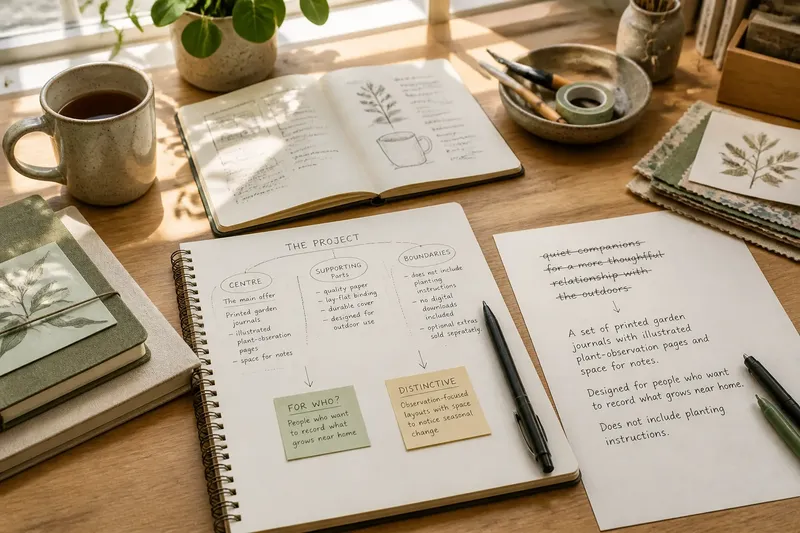
Mark the words that describe the form and the words that describe the creative choice. If the form takes up the whole sentence, add the choice. If the choice is present but vague, replace “something meaningful” with the specific quality you want to bring out. Keep the parts that help you decide what to make next; move the rest into notes.
Read the line aloud once. If it sounds like a promise to an audience rather than a thought that can guide your work, rewrite it in your own speaking voice. A little roughness is no problem. The sentence should feel usable at the desk, in a sketchbook or during a conversation with a collaborator.
What should you do when the sentence feels stuck?
What if I have several possible ideas?
Write a separate sentence for each, keeping the wording simple. Compare the creative choices they name; if those choices differ, you may be looking at distinct projects rather than competing versions of one idea.
Should I include the audience?
Include a reader or participant when that person’s presence changes the creative choices you make. If the sentence is mainly helping you understand the work itself, leave audience detail for a project description.
What if the final format is undecided?
Name the subject, method or experience you want to explore without forcing a format. A project can begin as an inquiry before it becomes a book, event, object or service.
When should I rewrite the sentence?
Revise it when your understanding of the project’s central choice changes. Do not rewrite it simply because you found a more fashionable phrase or a tidier rhythm.
Let the sentence point to one small decision
Once the line names a creative choice, ask what you can do next to make that choice more concrete. You might sketch two versions, gather a few visual references, try a material or outline a short activity. Choose an action that helps you see whether the idea still holds your interest.
Keep the one-sentence idea near your working notes, and let it change as the project changes. For a one-sentence idea, success is not a perfect line; it is a clearer question you can carry into the next making session.